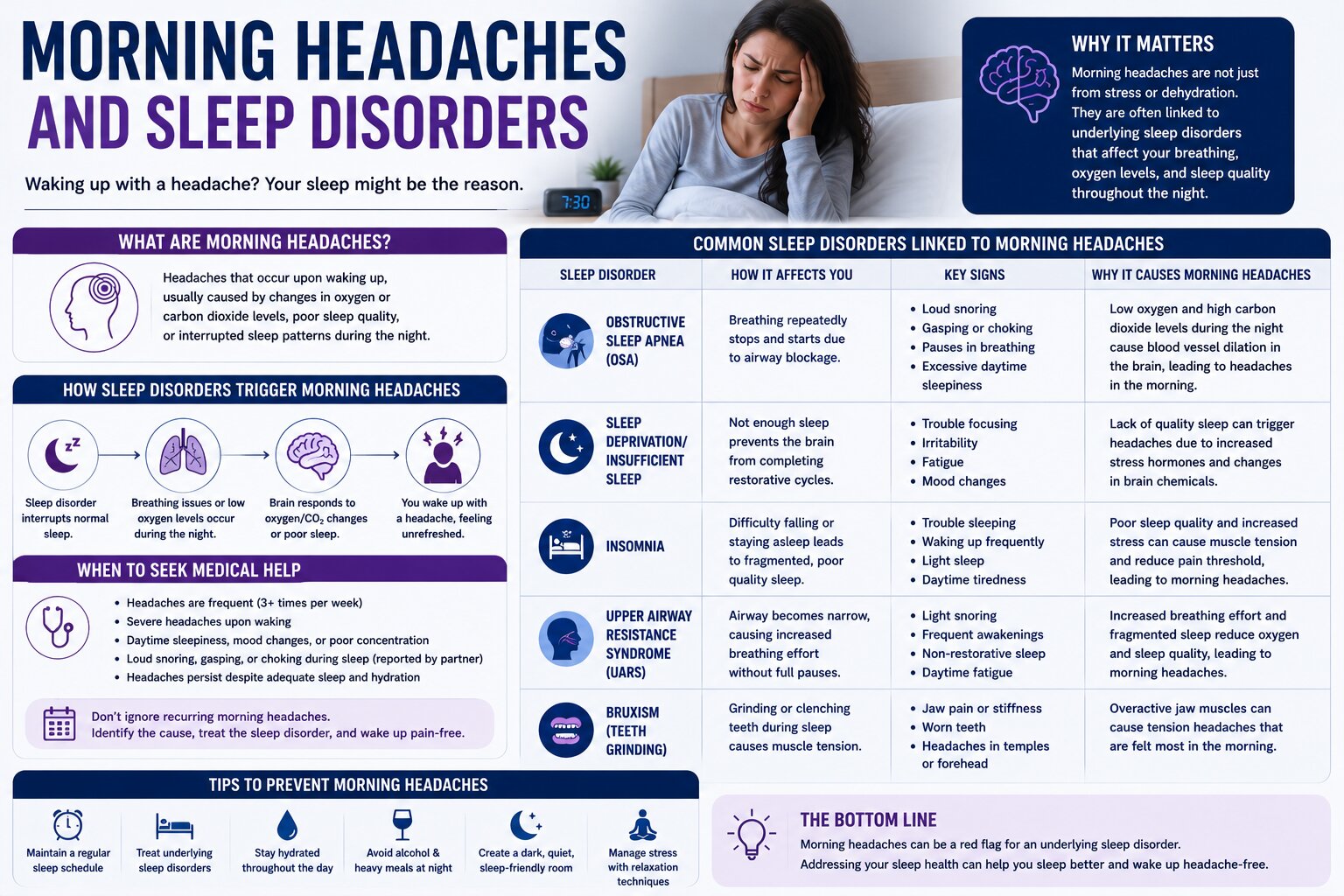
Waking up with a headache is not normal, even though many people accept it as part of their routine. Morning headaches are one of the most consistent symptoms of sleep apnea, caused by repeated drops in oxygen and rising carbon dioxide levels during the night. But sleep apnea isn't the only explanation. Bruxism, poor sleep quality, medication patterns, and specific headache disorders that occur during sleep can all produce the same morning pain. Identifying the cause is what determines whether treatment works.
Why Morning Headaches Are Different
Most headaches develop during the day in response to stress, dehydration, tension, or other triggers. Morning headaches are different because they're present on waking, before the day has started and before any obvious trigger has occurred.
That timing is clinically meaningful. It points toward something happening during sleep itself rather than a daytime trigger. The body has been doing something through the night that produces pain by morning.
Sleep specialists see morning headaches regularly. They're often one of the first symptoms patients mention, usually alongside tiredness, poor concentration, or a partner's observation about snoring. That combination, particularly headache alongside fatigue and snoring, is worth investigating specifically.
Sleep Apnea and Morning Headaches
Sleep apnea is the most common sleep-related cause of morning headaches seen in clinical practice.
Why does it happen? During each apnea episode, breathing stops. Oxygen levels in the blood fall. Carbon dioxide builds up. The brain is sensitive to both of these changes. Repeated episodes through the night create a pattern of low oxygen and elevated carbon dioxide that dilates blood vessels in the brain. That dilation is what produces the headache.
The headache typically appears on waking and eases within an hour or two as breathing normalises during the day. It tends to be felt across the forehead or as a diffuse pressure rather than a sharp or one-sided pain. Both sides of the head are usually involved. It's rarely severe enough to be debilitating, but it's consistent, often happening every morning, or most mornings, for months or years.
Many patients describe having accepted morning headaches as just how they feel in the morning. They don't connect it to sleep at all. When they finally get assessed and treated for sleep apnea, the headaches often resolve within weeks. That resolution, when it happens, tends to be one of the more striking early signs that treatment is working.
A home sleep test or overnight sleep study can confirm whether sleep apnea is present and producing the headache pattern. If you wake with headaches regularly and haven't had your sleep checked, that's a reasonable starting point.
Bruxism: When the Jaw Is the Problem
Bruxism is the grinding or clenching of teeth during sleep. It's more common than most people realise, and many people are unaware they do it until a dentist notices wear on the teeth or a partner hears the sound.
The headache from bruxism typically feels like tension across the temples or at the sides of the head. The jaw muscles work hard during sleep, often harder than they would during normal waking activity and that muscular effort produces pain that's present on waking.
Some patients notice jaw soreness, facial muscle ache, or tooth sensitivity alongside the headache. Others have no jaw symptoms at all and only notice the head pain.
Bruxism and sleep apnea can coexist and may in some cases be related. The arousal events from sleep apnea can trigger jaw clenching. Treating sleep apnea sometimes reduces bruxism frequency as a result. This is worth knowing because treating bruxism in isolation, without checking for sleep apnea, may produce incomplete results.
A dental assessment can confirm bruxism. A custom night guard worn during sleep protects the teeth and reduces the muscle tension that produces headaches. Where sleep apnea is also suspected, a sleep assessment runs alongside dental management rather than instead of it.
Poor Sleep Quality Without a Specific Disorder
Not all morning headaches from sleep are caused by a diagnosable sleep disorder. Poor sleep quality generally fragmented, insufficient, or disrupted by noise, light, or irregular timing can produce headaches on waking.
Sleep deprivation specifically is a recognised headache trigger. When the body consistently doesn't get enough deep, restorative sleep, the threshold for headache lowers. The pain isn't from a specific physiological mechanism like oxygen drops in sleep apnea. It's from the general physiological stress of inadequate rest.
This is more likely to be the cause when headaches are present after genuinely short nights rather than every morning regardless of how long the person slept. The pattern is important. Headaches that occur even after eight hours in bed suggest something happening during sleep rather than simply not enough sleep.
Medication Overuse Headache
This one is frequently missed.
People who take pain relief medication for frequent headaches, including common over-the-counter options, can develop medication overuse of headache. The medication that initially relieves headache begins to produce its own headache pattern when used too regularly, typically more than ten to fifteen days per month.
Morning headaches are characteristic of this pattern. The medication wears off overnight. The headache arrives before the first dose of the day.
It's worth considering if someone has been taking pain medication for morning headaches regularly for several months. The solution is gradual withdrawal of the overused medication under medical guidance, which often produces a temporary worsening before the pattern improves.
This doesn't rule out sleep apnea or bruxism as underlying causes. Both may have triggered the initial headaches that led to medication overuse. Treating the underlying cause while addressing the medication pattern produces the best outcome.
Hypnic Headache: The Alarm Clock Headache
Hypnic headache is less common but worth knowing about, particularly in older adults.
It's a specific headache disorder where headaches wake the person from sleep at a consistent time each night often described as an alarm clock headache because of its regularity. The headache is typically mild to moderate, lasts between fifteen minutes and several hours, and occurs on both sides of the head.
Hypnic headache is most commonly seen in people over fifty. It's considered a primary headache disorder, meaning it occurs without an underlying structural problem. Caffeine taken at bedtime is a recognised treatment in some patients, which surprises many people.
It's distinct from sleep apnea headache because it specifically wakes the person from sleep at a predictable time, whereas sleep apnea headaches are typically present on natural waking rather than causing a specific nocturnal awakening.
Where the pattern suggests hypnic headache, a neurological assessment is appropriate alongside any sleep evaluation.
Key Takeaways
- Morning headaches that are present on waking and ease through the day are a recognised symptom of sleep apnea and should be investigated with a sleep study.
- Sleep apnea headaches are caused by repeated drops in oxygen and rising carbon dioxide during the night. They tend to affect both sides of the head and resolve within a couple of hours of waking.
- Bruxism causes jaw muscle tension that produces temple or facial headaches on waking. It can coexist with sleep apnea.
- Medication overuse headache develops when pain relief is taken too frequently and produces morning pain as medication wears off overnight.
- Hypnic headache is a specific disorder that wakes people from sleep at a consistent time and is most common in older adults
Conclusion
Waking up with a headache every day isn't something to accept as normal. It's a symptom. In many cases it points directly to something happening during sleep that can be identified and treated.
Sleep apnea is the most common sleep-related cause, and it's worth investigating specifically before assuming the headaches are coming from stress, tension, or something unrelated to sleep. For many patients, the headaches are the clearest and most consistent sign that something is wrong overnight.
Dr. Syed Arshad Husain consults at Al Zahra Hospital, Dubai, with extensive experience in sleep medicine and respiratory conditions. If morning headaches are part of your daily pattern, a sleep assessment is a straightforward next step.
To book a consultation, call +971 04 378 6666.